Summary
Business process management (BPM) becomes important when work becomes more complex and cannot be managed effectively by a single individual. People in the business might know what needs to happen, but the execution path to get from point A to point B is jumbled and messy.
This guide looks at business process management from an operational perspective. Specifically, we’ll look at how teams identify issues in their processes, how workflow tools fit into BPM, and how organisations move from documenting processes to having them governed, measured, and continually improving.
- Why business process management matters when teams are managing complex, repeatable work across people, systems, and approvals
- How process problems show up as delays, duplicated effort, unclear ownership, and weak reporting
- The difference between business process management, workflow management, and automation
- A practical framework for identifying which processes need better structure
- How workflow software helps turn process design into day-to-day operational control
- How Screendragon’s workflow software supports process execution through workflow design, automation, approvals, governance, reporting, and integrations
Your campaign request is in one spot; your resource plans are somewhere else; your approval process is in another thread; and then your reports come in after your project is already behind schedule. The only way to solve this is to implement proper business process management.
What is business process management (BPM)?
Business process management is a company’s process of mapping and improving all aspects of its main business processes, end-to-end. A marketing team may develop standardised processes for requesting, building, reviewing, and launching new campaign projects to ensure each project follows the same stages. Standardisation helps maintain consistency in tasks, eliminates errors, and enables better business scaling without relying on memory or manual follow-up.
BPM maturity: How process control improves over time
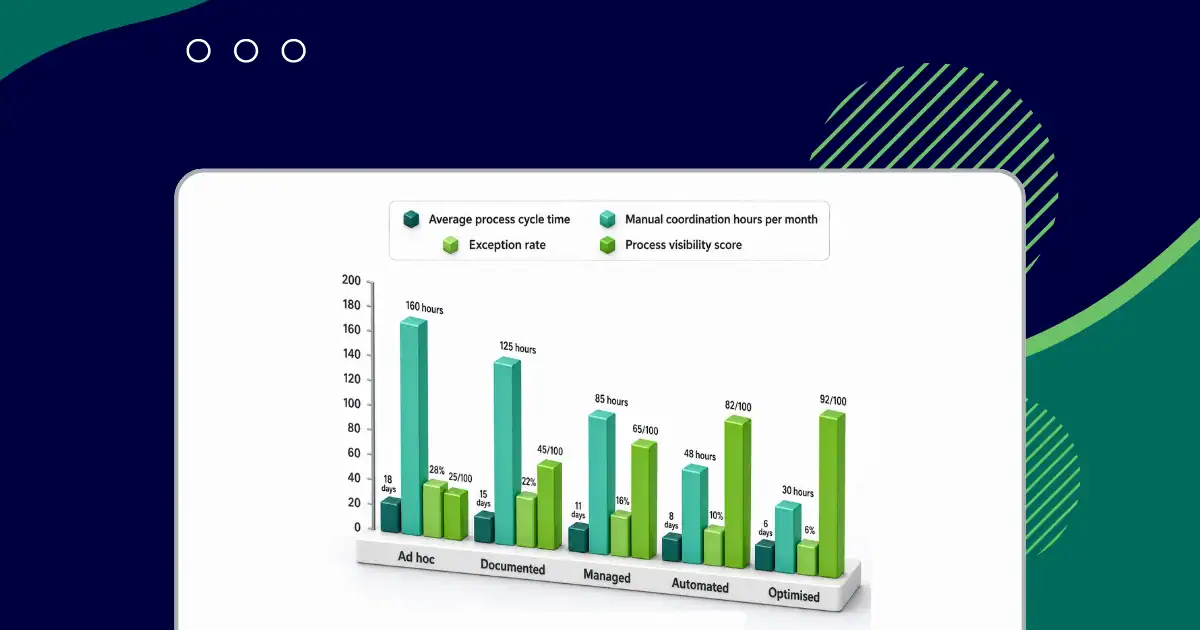
When using business process management as a reference point for understanding how team operational control evolves as business processes mature, it can be helpful to use the image below to describe how teams tend to move toward more formalised process controls as they become more structurally organised and quantifiable.
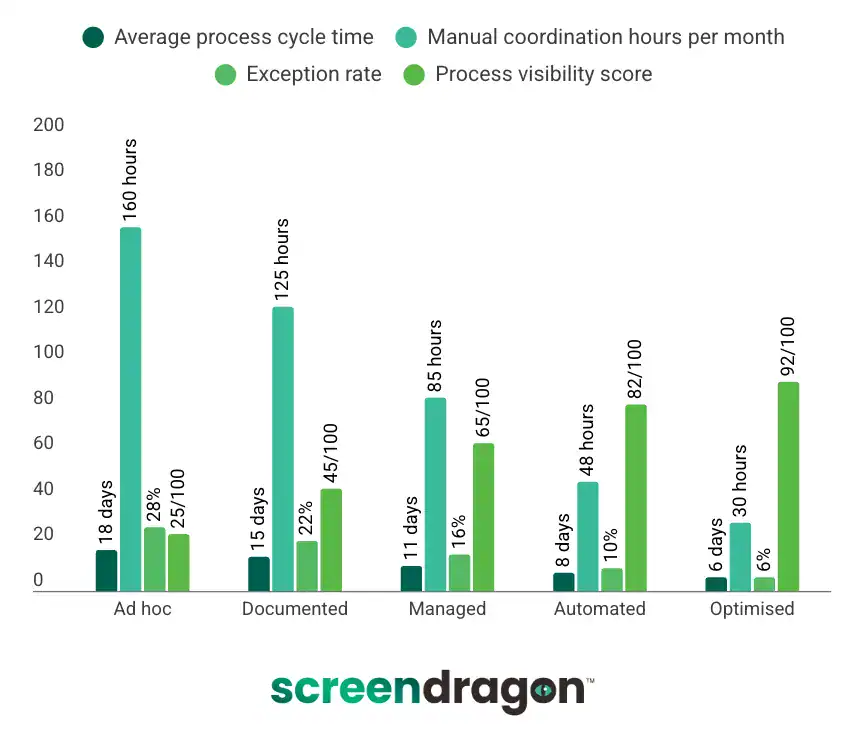
| BPM maturity level | Average process cycle time | Manual coordination hours per month | Exception rate | Process visibility score |
|---|---|---|---|---|
| Ad hoc | 18 days | 160 hours | 28% | 25/100 |
| Documented | 15 days | 125 hours | 22% | 45/100 |
| Managed | 11 days | 85 hours | 16% | 65/100 |
| Automated | 8 days | 48 hours | 10% | 82/100 |
| Optimised | 6 days | 30 hours | 6% | 92/100 |
This shows a directional approach to planning that defines where teams want their current and future operational patterns to go, rather than setting a fixed, absolute standard for assessing where a company should be in terms of its business process management maturity. This model is intended to illustrate typical BPM trends that many companies are trying to pursue.
What business process management really controls
Business process management is the practice of controlling processes to get more predictable results. The focus is on how all parties involved, employees, systems, decisions, and data, work together.
For marketing, creative, agency, and enterprise teams, this is important as work rarely stays within one group. It can include intake, prioritisation, resource allocation, creative development, compliance review and approval, delivery, and reporting.
The practical aim of business process management is not to make every process heavier. It is to make important processes easier to run, monitor, and improve.
This is where workflow software becomes useful. It gives teams a way to execute the process, not just describe it. Forms, routing rules, approvals, permissions, dashboards, and automation help convert process intent into operational behavior.
Where can you find business process problems at work?
Most of the time, process problems do not present themselves in an orderly manner. They commonly present as late work, repeatedly chasing people for information, duplicating efforts, lost information, rework, unclear assignment of responsibility, or reporting after all opportunities to make changes have been missed.
That is why BPM often starts with symptoms rather than theory. A leader may not say, “We have a business process management issue.” They may say that campaign approvals take too long, teams keep using the wrong brief, or nobody can tell which projects are blocked. Those are process signals.
Process symptoms worth investigating
- Work starts before the request is complete.
- Different teams follow different versions of the same process.
- Approvals depend on manual chasing.
- Managers cannot see where work is stuck without asking several people.
- Exceptions are handled informally and never reviewed later.
- Performance reporting shows outcomes but not the process conditions that created them.
Business process management vs workflow management vs automation
Business process management, workflow management, and automation are closely connected, but they are not the same. Confusion among these three areas can cause failures, so it is best to review the following in detail.
BPM is the larger discipline that studies how a process is developed, implemented, continuously monitored, and improved. Workflow management is more of an operational focus and includes understanding how tasks move from one step to another in daily business. Automation removes manual effort from workflows by automatically triggering actions, sending reminders, routing or transferring, updating, and approving.
Three layers of process control
These three concepts work best when they support each other. BPM sets the operating logic, workflow management runs the process, and automation removes avoidable manual effort.
| Business process management | Workflow management |
|---|---|
| Defines how important processes should operate and improve. | Controls how work moves through defined steps day to day. |
| Focuses on outcomes, governance, measurement, and cross-functional control. | Uses forms, routing, task rules, approvals, dashboards, and permissions. |
| Looks across teams, systems, approvals, and dependencies. | Helps teams execute processes consistently. |
| Helps leaders decide which processes need redesign or stronger management. | Turns process design into something people can actually use. |
A practical BPM framework for operational teams
A good business process management framework should avoid being too academic for operational teams. The first step should be to identify the most frequently used, cross-functional, high-friction, and strategic uses of the firm’s processes.
The goal is not to map out all tasks. Instead, the goal is to examine the processes with high costs due to inconsistent practices. In a marketing or agency-type environment, examples could include campaign intake, creative production, resource allocation, client approval, compliance review, localisation, asset delivery, and report creation.
Business process management step-by-step
| Step | Focus | What it means |
|---|---|---|
| 1 | Identify | Find the process where delays, rework, or unclear ownership create repeated friction. |
| 2 | Map | Clarify the inputs, outputs, owners, handoffs, approvals, systems, and exceptions. |
| 3 | Govern | Define who can request, approve, change, escalate, and measure the process. |
| 4 | Execute | Turn the process into a managed workflow that teams can follow consistently. |
| 5 | Improve | Use performance data to reduce delay, remove friction, and refine the process over time. |
By focusing on the entire process, this framework ensures that BPM stays grounded in reality. It shifts the focus from “our processes are poorly run” to “the problem lies within the intake phase; we don’t know who should approve a request, and there is no way for us to see how long it takes to complete an iteration.”
This framework will help you avoid the common issue of developing solutions for individual tasks while ignoring the problems of the overall process. For example, a team may be able to speed up the task-assignment phase of their workflow, yet they can never make up lost time due to poor briefing. Likewise, another team may develop procedures to speed up approvals; however, they will continue to have issues if resource capacity is not visible. For BPM to be effective, all aspects of a workflow must be addressed within a single integrated system.
Where BPM creates the most value
The greatest potential for business process management arises when work occurs with such frequency that formal structures should be developed for how to do it; however, at some point in the frequency of repetition or the complexity, informal coordination will no longer produce results. This is the area where incremental improvements can have a multiplier effect.
In terms of marketing operations teams, there may be value in having a clean intake process for requests and faster approvals. In terms of agencies, this may come from establishing standards for how projects are handed off and minimising the time spent chasing down task status.
For an enterprise brand team, the value could be stronger governance, greater transparency, and consistently executed programs across markets. Below are some common issues that marketing teams face, and how BPM can improve outcomes.
| Process area | Common issue | What BPM improves | Operational outcome |
|---|---|---|---|
| Campaign intake | Requests arrive with missing context | Standardised forms, required fields, clearer criteria | Fewer false starts |
| Creative production | Work moves through unclear handoffs | Defined stages, ownership, and task routing | Less waiting between teams |
| Approvals | Review depends on manual chasing | Routing rules, deadlines, reminders, and audit trails | Faster and more controlled sign-off |
| Resource management | Capacity pressure is visible too late | Better workload visibility and prioritisation | More realistic delivery planning |
| Reporting | Teams see results but not process causes | Dashboards for cycle time, bottlenecks, and exceptions | Better decisions for future work |
Why workflow software matters to BPM
The goal of BPM is to take a process developed on a whiteboard and implement it so employees can follow it. It is at this point that workflow software provides the actual execution layer for implementing a BPM solution. In other words, workflow software takes a defined business process, breaks it down into individual elements such as approval requests, dashboards, reminders, and permission settings, and allows users to create tasks within that process. This removes the reliance on individuals remembering each step of the process and limits the unnecessary communication required to coordinate individual tasks.
Our article on the best workflow software shows how this difference is important. Strong workflow software does more than provide a task list. Similarly, for agency work, Screendragon illustrates how disconnected tools and manual processes add complexity to daily work management by using workflow software to transform agency task management.
How Screendragon supports business process management
Screendragon is a BPM-friendly platform that allows users to create a design-to-deliver experience for managing their own workflows. This includes creating no-code workflows, dynamic custom form creation, embedding automation into your workflow, approval workflows, role-based permissions, reporting and dashboarding, and integration with other applications your team uses. With AI layered on top of the workflow automation components, agents can do more of the manual grunt work.
For operational teams, that means BPM can move beyond documentation. A campaign intake process can be managed as a workflow. A creative production process can include defined stages, assignments, approvals, and version control. A resource request process can capture the right information upfront and route work to the right team. A reporting process can show where work slows down and where capacity is under pressure.
When the process becomes operational
- Requests start cleaner: forms capture the information teams need before work begins.
- Ownership becomes clearer: tasks, approvals, and escalations follow defined rules.
- Governance is built in: permissions, audit trails, and approval paths support control without constant chasing.
- Improvement becomes easier: reporting shows where processes slow down and what needs to change.
A real-world example could include a corporate marketing team with multiple brand or region-based campaign requests in-take. Absent a structured process, intake, priority-setting, creative production, review, approval, and report-out may happen in a disjointed manner. With Screendragon, these separate activities can be managed through a single centralised platform, increasing transparency throughout the entire process and reducing the need for follow-up on non-structured communication.
In doing so, it is not just about establishing the process itself; it is about creating a more organised process flow. The organisation will be able to create standardised processes for repetitive work, better understand and manage exception-based activity, and use their workflow data to automate tasks and continually improve how they operate.
FAQ
Why does business process management matter for marketing and agency teams?
Teams in marketing and agencies perform similar tasks, such as producing creative, receiving approval, and managing deliverables. If processes are poorly defined or uncontrolled, most of this work is performed manually. As such, BPM will assist these types of organisations in eliminating unnecessary coordination, improving workflow visibility, and ensuring greater consistency in completing work assignments.
What are common signs that a business process needs improvement?
Some common indicators of poor business processes are duplicate requests for information, duplicative work efforts, unclear ownership or roles, delays in approvals, excessive amounts of time spent tracking the status of an issue or request, inadequate reports of project progress or status, and exceptions being resolved in different ways each time they occur.
How does workflow software support business process management?
Workflow software enables BPM by converting business process rules into day-to-day execution. Workflow software can also help facilitate the entire lifecycle of a request, including collecting information via intake forms, routing tasks to the correct individuals or approvals, and automating certain steps within the process.