

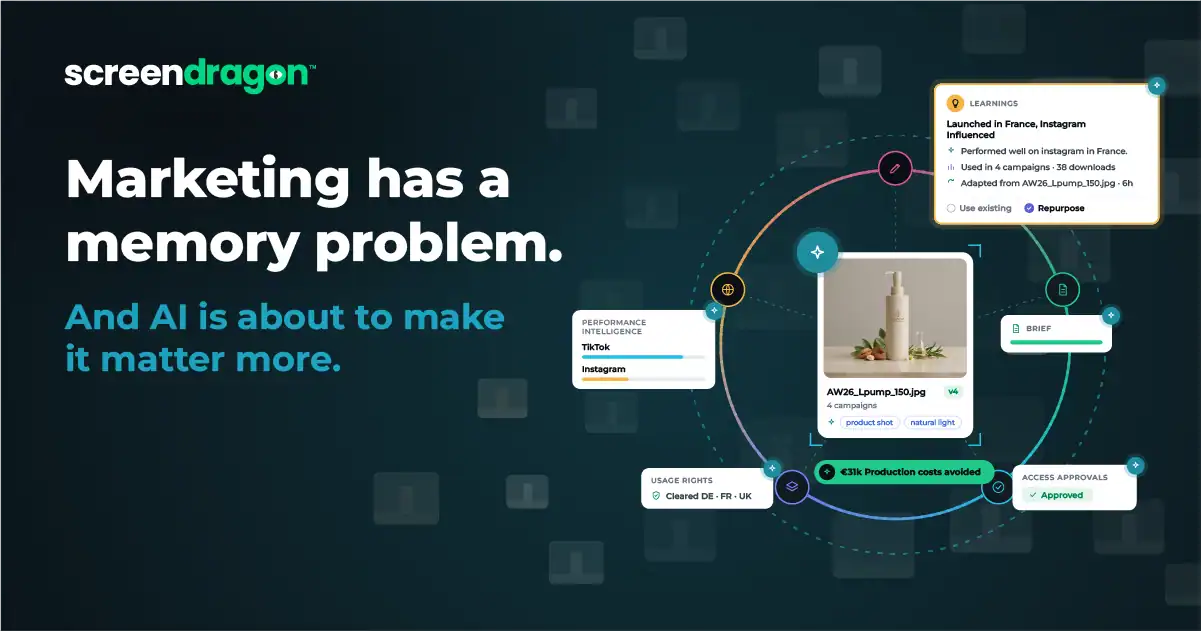
AI’s biggest marketing opportunity isn’t creating content, but due to its memory problem, It’s deciding what to create.
We are celebrating how much more content we can create.
And, to be fair, there is a lot to celebrate. AI is helping marketing teams explore ideas faster, adapt content more easily and take a lot of repetitive work out of the process. Things that used to take days can now take hours. In some cases, minutes.
But I keep coming back to one question. How can AI marketing decisions help us choose what is worth creating in the first place?
Was a shortage of content really the biggest problem marketing had?
For most large organisations, I don’t think it was.
We already had years of campaigns, thousands of assets and huge content libraries.
One of our enterprise customers recently told us that around 70% of their content is never used and as little as 2% gets used more than once.
So why are we using AI to solve a problem we didn’t have… and making the problem we really have worse.
That problem is:
Can we make better decisions about what is worth making?
Do we need something new? Is there already something we could reuse? Did we create something similar six months ago that performed well? Could that be adapted for this audience? Or is there a good reason to start again?
Those are ultimately questions about marketing effectiveness, not production efficiency.
And that is where I think the much bigger opportunity for AI sits.
But getting there is a journey as in most marketing organisations, AI doesn’t have enough of the picture to answer them.
Better Marketing Decisions Need Context
Think of AI as someone who has just joined your marketing team.
It hasn’t spent the last five years sitting in meetings. It doesn’t know why a particular campaign was launched or why someone made a certain decision. It hasn’t picked up all the background knowledge everyone else takes for granted.
It only knows what we expose it to.
And that’s where things get difficult.
The information it needs is usually there. It is just all over the place.
The strategy might be in a deck. Audience research somewhere else. The brief and approvals in a workflow platform. The final asset in the DAM. Performance data in another system again.
And plenty of the useful stuff is still buried in email, Teams, Slack, spreadsheets, meeting notes or someone’s head.
Marketing teams have been able to live with that for years because people fill in the gaps. We remember why something happened. We know who to ask. Someone copies information from one place to another. Someone else knows which version of an asset actually ran.
We have basically duct-taped our way around the problem and got the work done. But AI can’t do that.
For AI to help us make better decisions it needs context, it needs to be able to connect strategy, work, content, and outcome.
Most marketing organisations can’t do that consistently today.
And I think that is a much more important AI problem to solve than generating another 20 pieces of content.
So Where Should I Start?
Try following one asset.
Take one piece of content from a recent campaign and follow it from the very beginning to the very end. Ask yourself:
- Can you find the original brief?
- Can you see the business objective it supported?
- Do you know who it was aimed at and what audience or customer research informed it?
- Can you see what happened through review and approval?
- Do you know where the final asset was used, whether it was adapted, which market or channel it ran in and what happened next?
- Can you connect the result back to that specific asset?
- Did any of that learning make its way into the next brief?
My guess is that some parts of the journey will be very easy to follow and others will disappear surprisingly quickly.
Wherever that story becomes difficult to follow is where your context is weakest.
And that is where I would try and understand why.
Once You Find The Break, Work Out Why It Is Happening
Sometimes the technology genuinely is the problem. Two systems don’t talk to one another or the workflow stops before the next stage begins. But just as often, the technology is fine and the process around it isn’t. And many times especially on the work management side we the process and the technology sitting separately so you are dependent on people to implement the process correctly. And from experience that doesn’t scale.
Find One Important Gap and Fix That
Connect the brief to the finished asset. Bring agency work into the same workflow. Connect content performance back to the actual asset rather than stopping at campaign level.
And Then Move to the Next Gap
Over time you will begin to build a clearer picture not just of what content you have, but why it exists, where it was used and what happened as a result.
And that is where the real opportunity for better AI marketing decisions opens up.
Build a Marketing Organisation That Learns
Learning faster will be the advantage AI will bring. And that is learning in two ways
One where people learn from every campaign what worked, what didn’t, what should be reused, adapted or stopped.
But also one where AI learns with them.
Where the brief, the decisions, the content and the performance stay connected. Where every campaign adds more context to the system. And where AI isn’t starting from scratch each time but can draw on what the organisation has already done and what happened as a result.
That changes its role completely.
AI can start to recognise patterns across campaigns, surface work that is worth reusing, understand which approaches have performed well with different audiences and bring those learnings into the next brief.
The people get smarter along with the system around them.
Over time, marketing stops behaving like a series of disconnected campaigns and starts becoming a continuously learning operation with human judgement and AI learning from the same body of experience.
That, for me, is the real opportunity.
A marketing organisation powered by AI, where every campaign teaches both the team and the technology something that makes the next one better.