

Most marketing teams start new work and projects with a workaround. We’re witnessing how AI, automation, and governance have become priorities for maximizing efficiency. Yet some of the simplest fixes are still not being addressed.
At Screendragon, we engage with some of the world’s largest organizations on a regular basis. One issue many face is that work still kicks off through email threads, spreadsheets, messages, or verbal requests. We know that the way work arrives determines how much any of those priorities can actually contribute to greater efficiency.
The encouraging part is that intake is one of the more fixable problems in marketing creative and content operations. I’ll be specific about where I think it goes wrong.
Work still starts outside the workflow
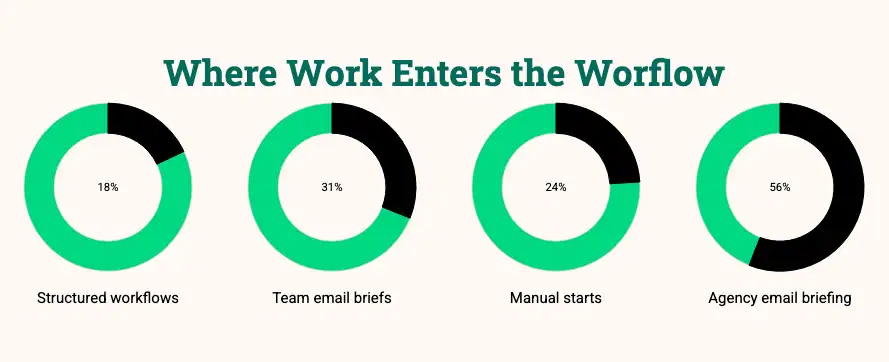
Reading that only 18% of work enters the organization through structured workflow systems really got my attention. That’s fewer than one request in five arriving somewhere it can be routed, tracked, and governed from the first minute.
Email is still the default starting point. In 2023, 37% of teams relied on email to manage intake and distribution. This year, 31% say they still receive briefs primarily through email. We’re moving in the right direction, but only modestly. Almost a third of teams are still running kick-off through an inbox, which is the most common intake channel and, by design, one of the least structured.
Unsurprisingly, the data shows that spreadsheets haven’t gone anywhere either. Some 24% still start work manually, including organizations in highly regulated industries, where you might expect the process around the work to be tighter.
Marketing and advertising agencies provide a stark example, with 56% of teams still relying on email for briefing, well above the overall figure. You might expect scale to force the issue, since agencies handle briefs from many clients at once. Instead, agency growth hasn’t fixed the intake issue. In many cases, it seems to have contributed to even more email threads.
Why intake is the hardest habit to break
When I put those numbers next to the investment happening elsewhere, it’s hard to square. We see teams putting money and attention into AI, automation, and governance, but all three require work to arrive in a consistent format, such as a structured form, for them to work effectively.
If a request starts in a message thread or a conversation in the corridor, everything behind it inherits the mess. You’ll see details missing from the brief, and much of the team may be unable to say who asked for what, when, or why.
So why does it persist? In my experience, it’s because the workaround is the easiest path in the moment. People are in their email throughout the day, and a verbal request takes ten seconds. A structured request, by comparison, can feel like friction to the person making it, even though it removes a lot of friction for everyone who touches the work afterward.
That mismatch, a small cost at the start versus a high cost downstream, is why ineffective intake methods survive every round of tooling upgrades. We see that most organizations are proactive in modernizing the middle and end of the process but have left the front door exactly as it was.
What structured intake actually looks like
Let me outline the alternative. Structured intake means a request arrives once, in one place, carrying what the work needs: the objective, audience, deliverables, deadline, budget, and who needs to approve it. It reaches the right person automatically, with an owner and a status from the outset.
From there, the brief becomes the start of the record, not a document that gets copied, edited, and reattached as the work moves. AI can help generate the brief using historical data and provide a first draft of content as the work progresses. Approvals are automatically routed through a defined workflow and presented to the right people at the right time. Discussions and edits across the brief, assets, and approval stages remain recorded and visible.
That’s what we’ve built Screendragon’s workflow software around: work comes in through a structured request, moves through defined steps, and stays visible from brief to delivery.
This approach provides the foundation AI and automation need, because without that structure, they can’t contribute effectively to team efficiency.
How to bring work inside the workflow
I’ll reassure you that none of this needs a big-bang program. If you recognize your organization in those numbers, I wouldn’t start by banning email. I’d start by making the structured intake route easier than the workaround people are used to:
- Pick the intake channel causing the most pain and fix that first
- Agree on the minimum information a brief needs before work can start, and make sure the structured request captures it
- Route requests to a named owner automatically so the work is visible and recorded
- Redirect requests rather than refusing them: when a request arrives by email, move it into the system and reply with the link, so the habit changes without the relationship souring
After a few weeks, measure the impact. One useful indicator is the share of work entering through the structured process. If more work is starting with clearer inputs and moving through delivery more efficiently, you can begin to see whether your investment in AI, automation and governance is delivering better results further along the workflow.
My Final Thoughts
My overarching message here is to fix the beginning. Marketing teams and leaders have the ambition for AI, automation and governance; they’re just not always starting in the right place. Until work enters through a structured route, each of those investments starts with a lack of clarity around the ask. Ultimately, fixing intake is what determines whether everything else works.
That’s why I’d rather see a team move more of its work onto structured intake than add another AI tool. It’s a smaller change, it’s within a team’s own control, and I guarantee it will show up in the numbers downstream. We need to remember that the goal isn’t AI; it’s efficiency.

You can read the full findings in our State of Creative and Content Operations 2026 report, based on our survey of 500 marketers across the US and UK. I’d be curious to know how much of your own work still starts with a workaround.
CMO, Screendragon