


Overview of Highlights
Screendragon’s AI Content Ops Summit made one thing clear: we’re entering a new chapter in how marketing work actually gets done. The discussions went beyond the hype-filled version you hear online to take a deep look inside the engine room shift happening across creative, production, and operations teams. Speakers demonstrated what happens when AI moves from initial experiments to integrated workflows, supporting people and decision-making at every stage of the marketing content lifecycle. The conversations were honest about what’s worked, what’s failed, and what teams and leaders need to rethink if they want to thrive in this new marketing environment.
The content below offers a walkthrough of highlights that stood out during the Screendragon summit, and why they matter for anyone responsible for making marketing run.
What’s New for Content Ops:
Speakers: John Briggs, CEO at Screendragon, and Clive Sirkin, (former) Chief
Growth Officer at Kellogg’s
John’s main theme is that AI is full of extremes, with hype on one side and disappointment on the other. Operators need a practical way to bridge that gap. The way forward, he said, isn’t magic—it’s clarity. Success comes from clear goals, clean data, trust in outputs, and an orchestration layer that connects all the moving parts of an organisation.
John encouraged teams to start with practical use cases, especially focusing on document-heavy, repetitive work that drains time but adds little creative value. He stressed the need for orchestration, where AI models or systems work together seamlessly in one application. Without this connected system, AI ends up as a collection of experiments instead of something that improves everyday work.
John repeatedly highlights that success requires the right foundations:
- Clear ROI and purpose
- Data readiness (“What comes in comes out.”)
- Skills to maintain and adapt AI systems as they evolve
He explained how Screendragon is built to solve that problem by combining workflow structure with AI agents.
“Screendragon began as a workflow platform focused on removing “make work” from individuals and teams. Now, with AI agents layered in, the platform removes even more low-value tasks at scale.“
“Screendragon’s AI Foundry is an expert consultation team that exists to help organisations define value, plan their AI roadmap, and continuously update solutions as models evolve.”
Ending his session, John delivered one of his strongest messages on adapting a new mindset. Highlighting that AI isn’t replacing everyone overnight, but people and organisations who avoid it will fall behind. The teams that lean in, learn how to use it, and get comfortable with managing the orchestration are positioned to benefit the most.
Watch John and Clive’s full discussion >
Behind the Scenes at Standard Life
Speakers: Dawn Player, Senior Marketing Transformation Lead at Standard Life and Fergus Ashe, CCO at Screendragon
Dawn’s session provided in-depth insight into what it really takes to bring AI into the heart of marketing ops, especially in highly regulated industries such as the financial sector. She showed that progress doesn’t begin with flashy AI tools, but with fixing your process first, making compliance part of the design, and proving value in a way that leaders can see and trust. Dawn emphasised the need to show clear, measurable value before expanding into broader AI initiatives.
Before her team began investing in AI, they reviewed every step in their workflow to ask:
“Is AI actually the solution here, or is the process itself broken?”
Dawn says this mindset helped them avoid “AI for the sake of AI” and instead focus on bottlenecks with measurable ROI.
Their first key use case was aimed at transforming the compliance stamp stage, which was taking the compliance team 20 minutes per asset. With an initial, intentionally narrow and low-risk pilot, Dawn’s team worked hand-in-hand with compliance and leadership to transform the process.
By training an AI agent to compare approved assets with DAM versions, flag differences, annotate issues, and auto-populate metadata, they uncovered more than 370 hours of annual savings and dramatically improved consistency and speed.
Watch Dawn and Fergus’s full discussion >
Scaling AI in the Content Supply Chain
Speakers:
Jon Saurez-Davis, Chief Strategy Officer at Transparent Partners,
Bryan Simkins, EVP of Technical Solutions at Transparent Partners
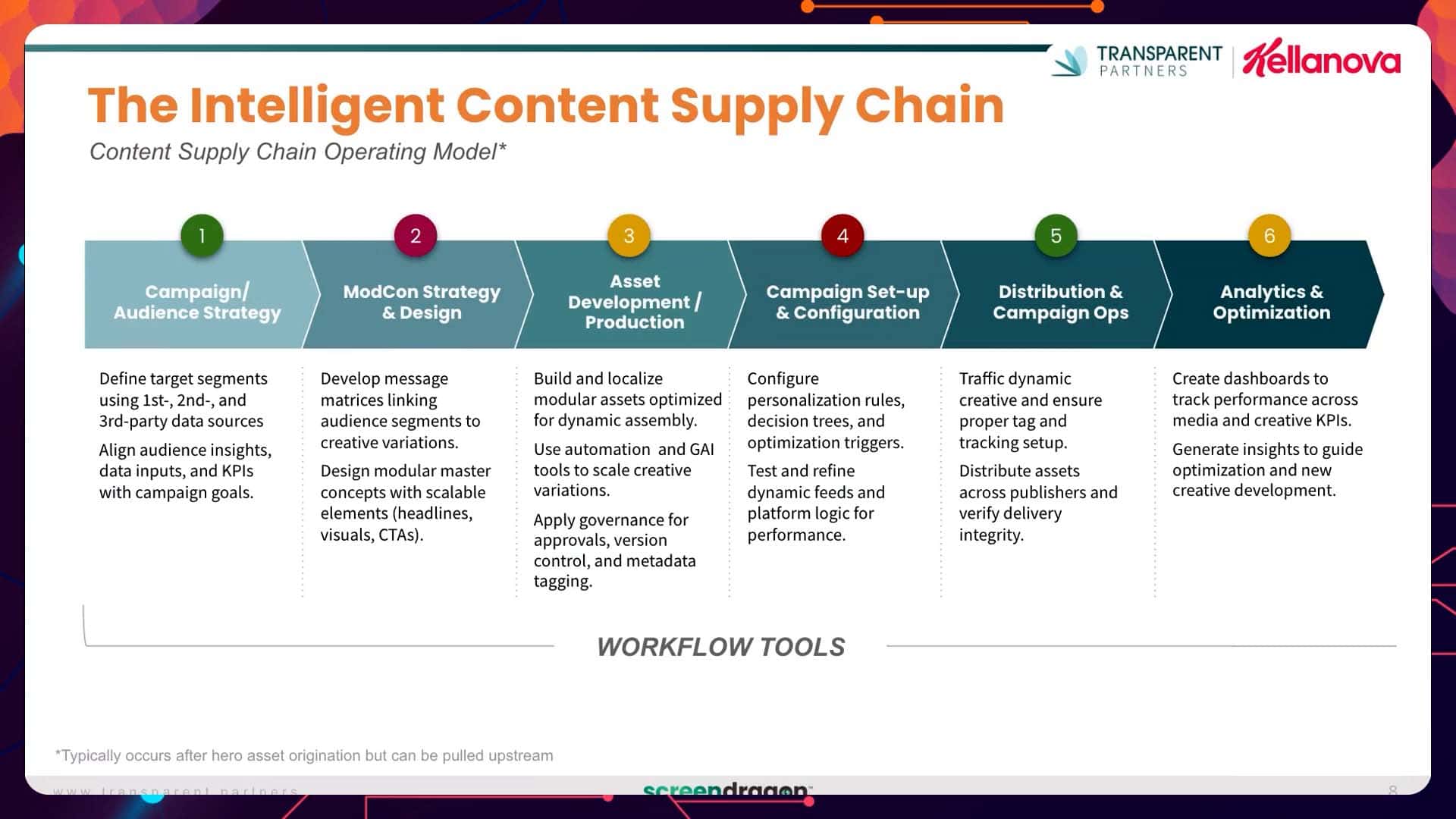
In this session, JSD and Bryan discussed why so many AI pilots stall before they produce real change. They showed that the roadblocks aren’t the AI models themselves, but the people, the structure, and the way work moves through an organisation. Their point was simple: before you adopt new tools, you must ensure leadership alignment, and that the content supply chain is mapped honestly end to end.
Bryan broke the technology ecosystem down into horizontal and vertical layers. Comparing the traditional horizontal content supply chain to a new intelligent version that is best operationalised by orchestration and workflow tools guiding content through campaign progression. His diagram highlights where organisations are typically strong in their processes and where they fall short. Bryan describes the vertical as the set of tools that help specialists do their craft, from copywriters, designers, producers, to editors. He emphasises that every craft has its own toolset, and giving each team the right tools matters just as much as the orchestration that connects them.
The session closed with a pragmatic outlook on the human–AI partnership: AI will accelerate the work, but humans will steer the strategy, judgment, and governance.
Watch JSD and Bryan’s full discussion >
Live Demo: Smarter Content Ops
Speakers: Fergus Ashe, CCO at Screendragon, and Sean O’Connell, Head of Customer Success at Screendragon
As you have read, earlier speakers covered strategy, use cases, and industry shifts. Fergus and Sean deliver a live demo showing how Screendragon uses agentic AI inside a structured workflow, detailing how:
- AI agents handle checks, annotations, and suggestions
- Humans remain in control through approval steps
- Screendragon orchestrates everything end-to-end
The most important takeaway from this session is that AI becomes powerful when connected to workflow logic. AI stays stuck in its own siloed corner when you use it alone. People end up copy/pasting between disconnected tools, and governance turns into a headache. Put it inside Screendragon and you get a set order, real structure, and clear accountability.
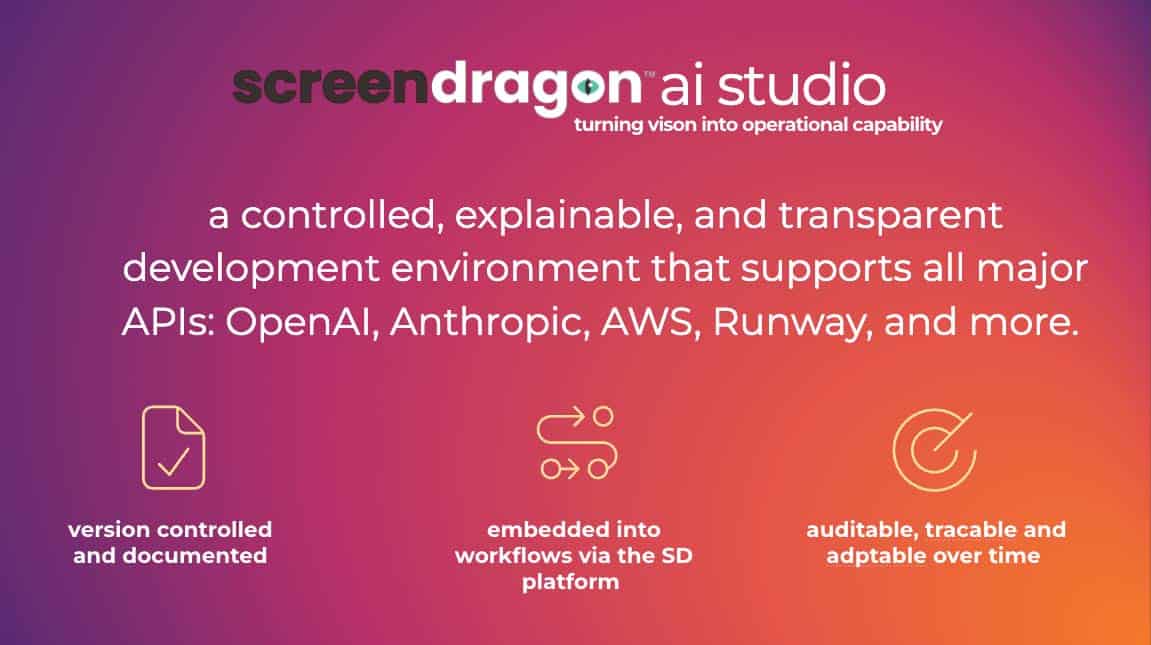
Their examples showed how teams can remove hours of manual checks, reduce compliance risk, and improve accuracy, all while keeping creative and legal experts focused on decisions.
Watch Fergus and Sean’s full AI demo >
Re-imagine & Win in the Age of AI
Speakers:
Rishad Tobaccowala, Author, Speaker & Marketing Innovator
Sangeet Paul Choudary, Author & CEO at Platform Thinking Labs
Clive Sirkin, (former) Chief Growth Officer at Kellogg’s
Sangeet Paul Choudary and Rishad Tobaccowala delivered a keynote that pushed well beyond AI hype. Their message was simple: AI isn’t just automating the work we do, it’s reshaping the systems we work in.
Sangeet unpacked this with his container analogy, showing how simple innovations can transform entire industries once organisations reorganise around them. In the same way, AI will reshape our ways of working, our roles, and competitive dynamics.
Rishad framed AI as a “new brain,” arguing that companies struggle because they’re trying to fit this new capability into old ways of working. Leaders, he said, are being buffeted by pressure from boards, budgets, and competitors, and need to define where they want to play before deciding how AI fits. Together, the pair encouraged teams to stop asking “What’s our AI strategy?” and instead revisit the fundamentals:
“Where do we play? How do we win? What capabilities do we need to win?” – Sangeet
Their stories from Figma vs Adobe to radiologists, sommeliers, and others bring their insights to life. To sum up, they encourage leaders not to race AI on its strengths. Focus on the part of the work where human value truly sits.
Clive Sirkin closed the session with a fitting theme for the whole Summit: reimagination, the biggest opportunity AI gives every leader, team, and individual.