

Summary
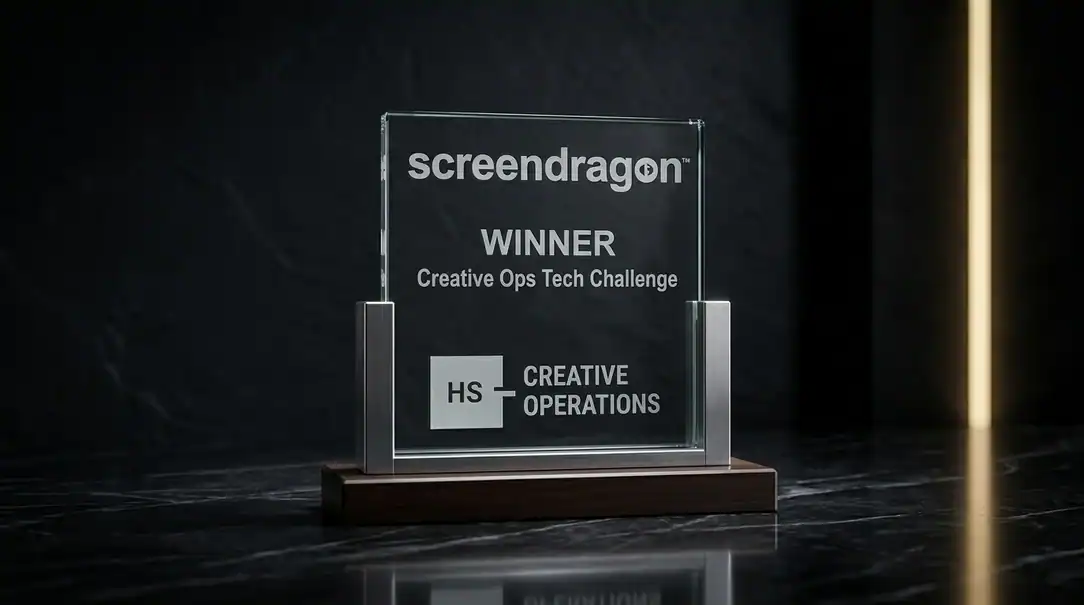
We are delighted to announce that Screendragon has been named the winner of the 2026 Henry Stewart Creative Ops Tech Challenge.
The tech challenge brought together leading Creative Operations technology providers to demonstrate how their platforms can address common operational challenges, improve efficiency and strengthen the way creative work gets delivered.
Representing Screendragon, Sean O’Connell and Greg Hides demonstrated how teams can connect briefing, content creation, human collaboration, AI-powered review and approvals in one end-to-end workflow.
Watch Screendragon’s award-winning session at the Tech Challenge below:
From an emailed brief to a live project
The tech challenge began with a familiar creative operations challenge: getting complete and accurate information into the workflow from the outset.
Traditional briefing forms can create friction. Briefs may be filled out incorrectly, contain missing information, or ask stakeholders to re-enter details they have already documented elsewhere.
Screendragon demonstrated a different approach. A user can simply email an existing brief as an attachment to an AI agent. The agent can then read the document, extract the relevant campaign information and use it to create a structured brief within Screendragon.
The example campaign brief included details such as:
- Brand and campaign information
- Timings and key stakeholders
- Campaign objectives
- Required channels and deliverables
Instead of manually copying this information into another system, the relevant fields were populated and the brief automatically entered the appropriate review process.
Keeping people in control of the briefing process
Automation does not remove the need for human judgement, and the human-in-the-loop conversation becomes even more important.
Once the brief had been processed, stakeholders can review the information, collaborate on it, request revisions or approve it before work began. This combination of AI-powered intake and human approval enables teams identify incomplete or inaccurate information before it causes confusion and rework later in the process.
Following approval, Screendragon converted the brief into a live project while preserving the original context. Milestones, planning tools, dependencies and resourcing capabilities were brought together within the project.
Using Screendragon’s advanced automation capabilities, the required content workflows were generated from the deliverables identified in the brief, including a video production workflow, digital advertising workflow, email marketing workflow and a content kit.
Carrying context into content creation
One of the central the central themes Sean presented in the demonstration is continuity.
Information captured in the original campaign brief flowed into each relevant content brief, removing the need for teams to repeatedly re-enter the same details. This reduces administrative effort while also limiting the mistakes and inconsistencies that can occur when information is manually transferred between tools or teams.
Screendragon’s AI brief writer agent is embedded directly within the brief form. Users can select details such as the region, language, product, channel and campaign theme before prompting the agent to produce copy aligned with those parameters.
The generated copy can then be reviewed, refined with AI where appropriate and submitted for approval without leaving the Screendragon system.
Rather than operating as a separate chatbot or disconnected content-generation tool, the AI brief writer agent formed part of the governed process surrounding the work.
Intelligent routing without the manual chasing
Once the copy is submitted, it automatically moved to the appropriate review stage.
Screendragon’s workflow automation can be configured for different brands, teams and areas of the business, allowing work and projects to move smoothly between workflow stages. Users do not have to manually identify the next reviewer, forward files through email or chase colleagues for updates.
Following copy approval, the work is assigned to an available designer and the relevant person notified automatically.
This gives creative operations teams greater control over how work progresses while enabling creatives and reviewers understand what they need to do next.
AI-powered brand guideline checks
Sean then moved from content creation into artwork review.
After a design file is uploaded, an AI brand compliance agent trained on the relevant brand guidelines reviewed the asset. The agent flagged issues and added annotations directly to the file for the design team to assess.
Teams can see the findings within the wider approval process or open the asset to review each annotation in context. Human reviewers can also add their own feedback, manage new versions and compare files side by side.
This showed how Screendragon’s AI capabilities support time-consuming quality-control activities while keeping designers and brand stakeholders responsible for the final decision.
Connecting people, processes and AI
Our demonstration presented a connected journey from initial request to content delivery:
- An existing brief gets submitted by email.
- An AI agent extracted and structured the campaign information.
- A human reviewed and approved the brief.
- Screendragon created the project and its associated content workflows.
- Brief information flowed into individual deliverables.
- AI helped generate content within the workflow.
- Work gets routed automatically to the appropriate reviewers and creators.
- An AI agent checked the artwork against brand guidelines.
- Human reviewers assessed the findings and moved the asset towards completion or delivery to a DAM.
The demonstration illustrated that the value of AI in creative operations does not come from automating one isolated task. It comes from embedding AI within a structured operating environment in which briefs, people, content, approvals and brand requirements remain connected.
Using Screendragon teams can reduce repetitive administration and manual handovers without sacrificing governance or human oversight.
A winning vision for Creative Operations
We are proud that Henry Stewart’s Creative Ops Tech Challenge recognised Screendragon’s approach to orchestrating creative work.
Congratulations to Sean O’Connell and Greg Hides for representing Screendragon on the day, and thank you to Henry Stewart Events for organising the challenge.
If you would like to explore how Screendragon can connect your briefing, content, approval and AI processes, book a personalised Screendragon demo.


